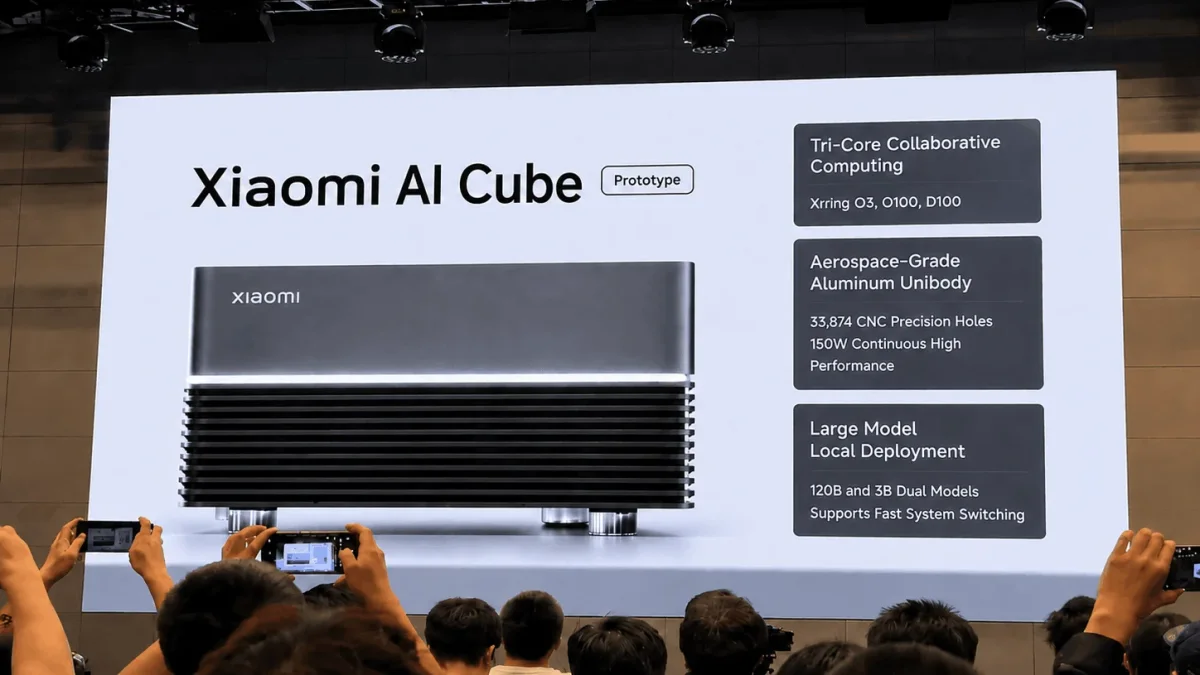
Xiaomi has expanded its self-developed chip lineup with three new Xring processors, including a dedicated AI accelerator for on-device processing.
CEO Lei Jun introduced the chips at the company's autumn flagship launch event.
The new AI accelerator, named Xring O100, delivers up to 1.22TB/s of memory bandwidth.
Xiaomi claims it is the world's first 6nm 3D wafer-level stacked advanced packaging solution.
The chip uses hybrid bonding with a pitch close to the physical limit, giving it 16 times the memory bandwidth of traditional mobile phones.
This enables on-device inference speeds of 330 tokens per second.
The design stacks logic and high-speed DRAM dies vertically using wafer-on-wafer technology and hybrid bonding.
This shortens the physical distance between compute and memory, addressing the memory bottleneck that limits large language models on edge devices.
Even with powerful mobile SoCs, slow data transfer often hampers performance.
The O100's high bandwidth and dense connections aim to accelerate token generation for on-device models.
It features a multi-core NPU optimized for different inference stages and supports dynamic data routing.
Xiaomi has shown prototypes, including tablet-style devices and the 'Xiaomi AI Cube' mini-PC, pairing the O100 with other Xring chips for sustained local AI workloads.
Commercial availability is expected in 2027, with potential use in smartphones, tablets, robotics, and more.
The O100 is part of the broader Xring family, which also includes flagship mobile SoCs and automotive chips.
Instead of focusing solely on smaller process nodes, Xiaomi emphasizes bandwidth and packaging improvements.
The goal is to make generative AI responsive, private, and usable offline.