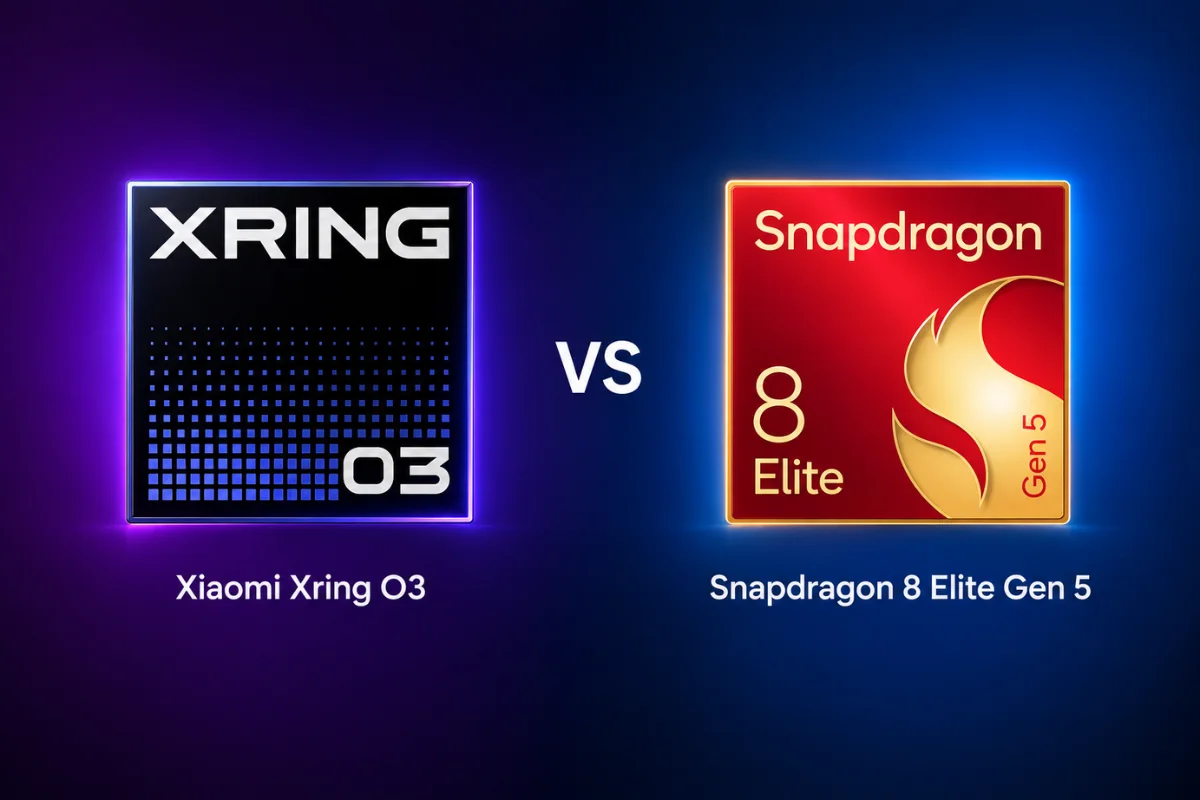
Xiaomi has unveiled its second smartphone chipset, the Xring O3, which brings notable upgrades over its predecessor.
The new chip features ARM's latest C1-series cores, a more powerful GPU, and an upgraded NPU.
Xiaomi claims the Xring O3 outperforms rivals like Apple's A19 Pro and Qualcomm's Snapdragon 8 Elite Gen 5 in its own benchmarks.
Specifications at a Glance
The Xring O3 is built on TSMC's 3nm process, similar to the Snapdragon 8 Elite Gen 5.
However, the Xring O3 has a larger die size of 133 sq. mm compared to 126.2 sq.
mm for the Snapdragon.
In terms of CPU, the Xring O3 uses a tri-cluster setup with cores clocked up to 4.35 GHz.
The Snapdragon 8 Elite Gen 5 features Oryon Gen-3 cores reaching up to 4.61 GHz.
For graphics, the Xring O3 packs a 16-core Mali-G2 Ultra GPU running at 1.6 GHz.
The Snapdragon uses an Adreno 840 GPU at 1.2 GHz.
Both chips support LPDDR5X memory, but the Xring O3 supports LPDDR6 up to 5333 MHz.
Connectivity options include 5G modems, Wi-Fi 7, and Bluetooth 6.0 on both.
Benchmark Performance
In Geekbench tests, the Xring O3 scored 3,945 in single-core and 15,221 in multi-core.
The Snapdragon 8 Elite Gen 5, by comparison, scored 3,726 and 11,402 respectively.
On AnTuTu v11, the Xring O3 achieved an impressive 5.22 million points.
The Snapdragon 8 Elite Gen 5 trails with around 3.9 million points.
These results come from Xiaomi's internal testing, which may not reflect real-world performance.
The Xring O3 debuts in the Xiaomi 18 Fold and Xiaomi Pad 9 Pro Max.
Independent benchmarks will provide a clearer picture once these devices are available.