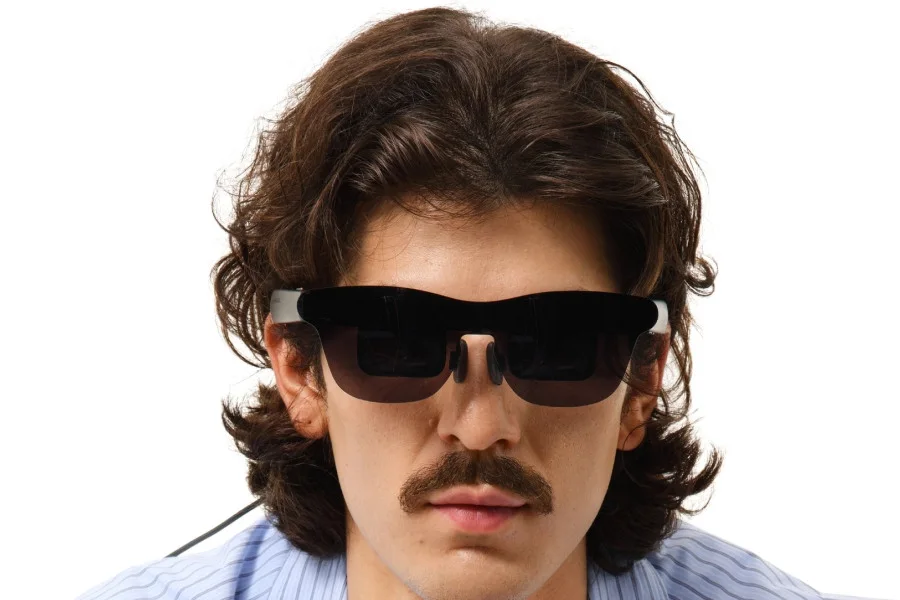
Chinese AR brand RayNeo has introduced its new GT series of augmented reality glasses, starting with the RayNeo GT Max.
The lineup is positioned as a premium option for a "professional film and television-grade" viewing experience, distinct from the company's lighter Air series.
>>> RayNeo GT Series Brings Dolby Vision and Spatial Audio to AR Glasses
The official launch is scheduled for May 27 at an event held at the TCL Chinese Theatre.
Display and Optics Upgrades
The RayNeo GT Max boasts a 59-degree field of view, a significant increase from the typical 45 degrees found in most movie-oriented AR glasses.
This is achieved through the company's self-developed Peacock Optical Engine 3.0 Max and a new hybrid prism light module.
According to RayNeo, the setup creates a virtual screen equivalent to a 267-inch display viewed from six meters away.
>>> Edifier S260 Retro Bluetooth Speaker Launches with LDAC and AirPlay 2
The glasses also incorporate a new generation Micro-OLED display and a dedicated Vision 4000 image quality chip for improved color accuracy and video processing.
Dolby Vision and Spatial Audio
RayNeo has partnered with Dolby Laboratories for the GT series.
When used with the RayNeo Magic Box 2 Dolby Vision Edition, the glasses become the first AR kit to support Dolby Vision playback, delivering cinema-style contrast and lighting.
>>> iQOO Z11 5G vs Redmi Note 15 Pro+: Battery, Camera & Performance Compared
For audio, RayNeo collaborated with Danish company Bang & Olufsen. The GT series features a quad-speaker setup with spatial audio and 360-degree head tracking.
Dual-Chip Architecture
The GT series introduces a dual-core system with the Vision 4000 chip and a custom Zone 360 spatial computing chip.
The latter enables native 3DoF spatial hovering and multiple viewing modes, including follow mode, fixed mode, and image stabilization.
Despite the enhanced features, the RayNeo GT Max weighs only 78 grams.
>>> Ugreen launches 45W 10,000mAh power bank with built-in cable and smart display
Alongside the GT series, RayNeo is expected to unveil its next-generation AI-powered shooting glasses, the V4, at the same event.