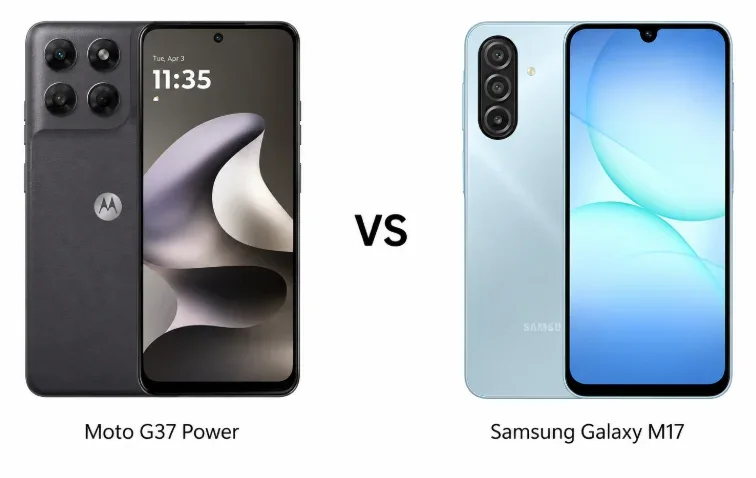
The Motorola Moto G37 Power and Samsung Galaxy M17 cater to different budget smartphone buyers.
The Moto G37 Power emphasizes massive battery life and performance, while the Galaxy M17 offers a sharper AMOLED display, versatile cameras, and long-term software support at a lower price.
>>> Vivo X300 FE vs OnePlus 15R: Full Comparison of Specs, Camera, Battery and Price
This comparison breaks down their everyday experience and value in the sub-₹16,000 segment.
Design and Display
The Motorola Moto G37 Power focuses on durability with an eco-leather finish, IP64 protection, and MIL-STD-810H certification.
Its textured rear panel feels premium, and stereo speakers plus a headphone jack add usability for media lovers.
The Samsung Galaxy M17 has a slimmer body with Gorilla Glass Victus protection, giving it a refined look.
It lacks stereo speakers and a headphone jack but feels more compact for daily carry.
Samsung wins on display with a Super AMOLED panel at Full HD+ resolution, offering richer colors and deeper blacks.
The 90Hz refresh rate is lower than Motorola's 120Hz, but visual quality compensates.
Motorola's 6.67-inch IPS LCD with 120Hz feels smoother during scrolling and gaming, but its HD+ resolution reduces sharpness for text and video.
>>> JBL Soundgear Clips Get Emerald Green Special Edition with Gold Accents
Performance and Battery
The Moto G37 Power uses a Dimensity 6400 chipset in India, offering faster app loading and gaming.
UFS 2.2 storage boosts real-world speed, and the 120Hz display enhances responsiveness.
Samsung's Exynos 1330 handles daily tasks reliably but lags under heavier loads. However, Samsung promises six major Android upgrades, making the software more future-proof.
Motorola dominates battery life with a 7000mAh cell lasting up to two days. It supports 30W wired charging and 6W reverse charging.
Samsung's 5000mAh battery provides full-day use but cannot match Motorola's endurance.
Camera
The Galaxy M17 features a 50MP main camera with OIS, a 5MP ultrawide, and a 2MP macro. OIS stabilizes low-light shots and video, offering more versatility.
Motorola has a single 50MP rear camera that captures detailed daylight shots and records 2K video. It lacks an ultrawide lens, limiting creativity.
Samsung's 13MP selfie camera produces sharper images with better skin tones. Motorola's 8MP selfie camera is acceptable but softer.