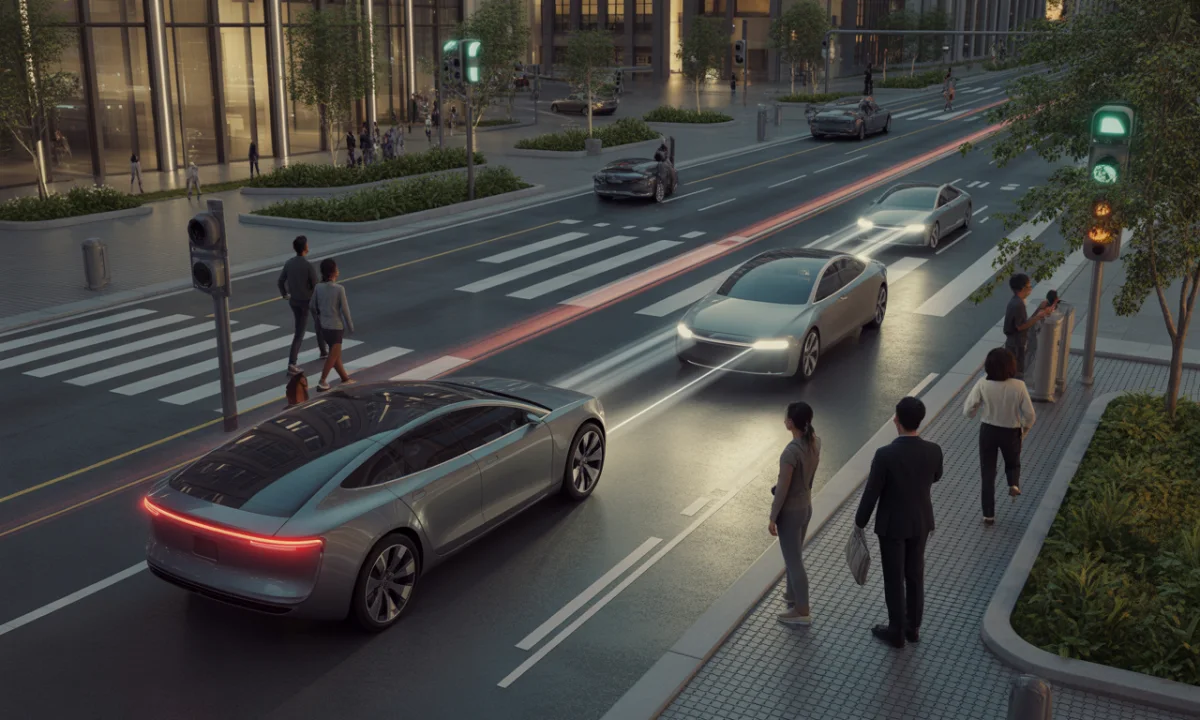
Autonomous vehicles are poised to reshape how societies move, work, and design cities.
As companies deploy advanced sensors, machine learning, and vehicle-to-infrastructure networks, the rise of self-driving vehicles promises profound gains in safety, accessibility, and environmental performance.
Proponents argue that eliminating human error could dramatically reduce crashes, while optimized routing and electric powertrains could cut emissions and congestion.
Yet, the transition also threatens to upend labor markets, redefine the automotive business model, and require massive investments in infrastructure and regulation.
Urban planners envision reclaimed parking lots and widened public spaces. Insurers, lawmakers, and ethicists foresee thorny questions of liability and algorithmic decision-making.
Market forecasts suggest a rapid expansion of autonomous fleets over the coming decades, but technical limitations—sensor performance in adverse weather, rare edge cases—and public distrust temper expectations.
The debate is no longer hypothetical: the integration of autonomous vehicle technology into daily life will determine whether its net effect is broadly liberating or unevenly disruptive.
Understanding Autonomous Vehicles and Their Classification
Understanding what a self-driving car actually is requires separating marketing from mechanics.
At its core, an autonomous vehicle combines sensors, compute, and software to perform driving tasks that humans traditionally execute.
Those elements work together to perceive the environment, predict the behavior of other road users, plan safe trajectories, and execute control commands.
The technical stack includes lidar, radar, cameras, GPS, high-definition maps, and layers of artificial intelligence that interpret raw sensor data in real time.
Not all autonomy is the same: engineers refer to the SAE scale to set expectations—levels range from simple driver assistance to full, unconditional autonomy.
Most consumer cars today sit at Levels 2–3, where the system can assist with steering and speed but still expects human oversight.
Research and testing are concentrated on achieving robust Level 4 operations in constrained environments and, ultimately, Level 5 across all conditions.
Those pursuing full autonomy face a chain of interdependent problems: reliable perception in adverse weather, decision-making in rare or ambiguous scenarios, and the energy and thermal constraints of high-performance onboard compute.
Yet, the long-term technical trajectory is clear: compute and sensing costs continue to fall while algorithmic performance improves.
Industry observers tracking innovation highlight the accelerating convergence of AI, sensor fusion, and fleet-scale data collection as the enabler of practical driverless services.
Grasping the engineering realities clarifies why deployment is incremental: companies are expanding from driver assistance to supervised autonomy and then to monitored robotaxi pilots.
Reports and experiments described by technology analysts and mainstream auto coverage show how each step tightens safety margins while giving regulators and the public time to adapt.
The technical foundation is mature enough to justify continued investment, but not yet immune to the edge cases that expose current systems’ limits.
Safety, Accessibility, and Environmental Advantages
The most persuasive argument for large-scale deployment of autonomous vehicles centers on safety.
Human error still underpins the overwhelming majority of traffic incidents, and removing key human failure modes—fatigue, distraction, impairment—can materially reduce collisions.
Autonomous systems, when properly validated, can continuously monitor surroundings, maintain safe following distances, and react faster than a human in many scenarios.
Those safety gains are not theoretical; they are the principal justification driving public policy and private investment.
Equally important are the mobility and social benefits.
Autonomous vehicles can restore independence to people who cannot drive today—older adults, people with disabilities, and those without licenses.
That shift toward inclusion alters travel patterns and expands labor market access.
Environmental arguments are also compelling: coordinated vehicle movements, smoother speed profiles, and integration with electrified drivetrains reduce fuel use and emissions.
Studies indicate measurable energy savings from optimized driving, and mainstream outlets tracking vehicle efficiency trends provide context for these claims.
Critics caution that benefits depend on deployment models.
Shared autonomous fleets maximize reductions in vehicle kilometers and parking demand, whereas privately owned autonomous cars could increase travel demand and energy use.
Policy choices and commercial strategies will largely determine whether autonomy produces net public good or simply reshuffles private costs.
Stakeholders are already exploring outcomes: research groups, industry analysts, and environmental commentators debate whether electrification plus autonomy will deliver the emission reductions proponents project.
To weigh these outcomes fairly, policymakers should tie approvals and incentives to measurable social objectives—reduced crashes, equitable access, and lower emissions—rather than treating autonomy as an end in itself.
Evidence-informed regulation and transparent pilots will determine whether safety, accessibility, and environmental gains actually materialize at scale.
Reshaping the Automotive Industry and Business Models
The rise of autonomous vehicles is not merely a technical evolution; it is a strategic rupture for the automotive industry.
Traditional manufacturers are transitioning from selling metal to selling mobility services.
That shift alters product design, revenue models, and partner ecosystems.
Companies that once focused on powertrains and dealer relationships now compete with software firms, cloud providers, and data-centric startups.
This reorientation favors firms that can monetize subscriptions, shared fleets, and on-demand ride services.
Market forecasts project steep growth in autonomous-related markets, attracting capital and prompting incumbent consolidation. Manufacturers are experimenting with robotaxi pilots, subscription fleets, and integrated mobility platforms.
At the same time, tech entrants leverage strengths in AI and user experience to capture value traditionally held by automakers.
Strategic alliances span sensor suppliers, telecoms for V2X connectivity, and logistics firms testing automated trucking.
Different commercial paths imply different winners and losers: OEMs that internalize software and data capabilities stand a better chance than those relying on legacy hardware sales alone.
Business modelCore value driverTypical actorVehicle salesUnit margin on hardwareTraditional automakersMobility-as-a-Service (MaaS)Utilization and subscriptionsFleet operators, startupsRobotaxi platformsData, routing, dynamic pricingTech firms & OEM partnershipsFleet management & maintenanceOperational efficiencyService providers
Winners will be those who control customer relationships and the data layer, not just the metal.
Analysts at McKinsey and other research organizations emphasize that the competitive landscape will reward integrated ecosystems and agility in forming cross-sector partnerships.
Firms that fail to adapt risk commoditization of their traditional businesses.
Urban Design, Labor Shifts, and Social Consequences
Autonomous vehicles will reshape cities as decisively as the original automobile did a century ago.
Reduced demand for curbside parking and private garages opens opportunities to repurpose land for housing, parks, and active transport.
Roadway design will evolve toward dynamic lanes, improved pedestrian spaces, and vehicle-to-infrastructure communication.
These changes are not automatic; they require coordinated planning, updated zoning, and public investment in smart infrastructure.
The labor implications are striking and politically sensitive.
Millions work in driving occupations—long-haul truckers, taxi and rideshare drivers, couriers—and some roles face automation risk.
But new jobs will emerge in software engineering, fleet operations, cybersecurity, and urban systems management.
The transition will be painful for many, which argues for proactive reskilling programs, transitional support, and targeted regional economic strategies.
Policymakers must weigh social stability against efficiency gains.
Beyond jobs, autonomy affects daily routines and time use. Commutes could become productive or restful time, shifting societal norms about work-hours and commuting.
Commercial logistics can become faster and cheaper, but that efficiency could also accelerate consumption and urban sprawl without proper policy guardrails.
Cities that anticipate these dynamics—by linking autonomous deployment to public transit, active modes, and compact urban development—will likely capture disproportionate benefits.
Case studies and journalism from diverse sources illustrate both optimistic and cautionary scenarios.
Evidence from pilot deployments suggests significant parking reductions and modal shifts where regulation and incentives align.
The ultimate urban outcome will depend less on technology and more on regulatory choices and market designs that favor public value over private convenience.
Remaining Technical, Regulatory, and Ethical Obstacles
Arguing for accelerated deployment requires confronting the unresolved barriers: technical limitations, fragmented regulation, and thorny ethical questions.
Sensors and AI systems still struggle with adverse weather, rare edge cases, and adversarial actors.
High-performance onboard computing consumes significant power and generates heat, creating engineering tradeoffs between capability and efficiency.
Technical robustness is a prerequisite for trust, and that robustness remains an ongoing engineering challenge.
Regulatory frameworks are uneven across jurisdictions. Governments must define safety certification, liability regimes, insurance rules, and data governance.
The U. S.
NHTSA and international bodies are drafting guidance, but patchwork rules create deployment friction.
Cross-border travel and mixed fleets raise further complexity. Policymakers need to balance enabling innovation with enforcing minimum safety and privacy standards.
Ethical dilemmas demand transparent public debate.
Autonomous systems will face unavoidable trade-offs in rare crash scenarios—decisions that implicate moral responsibility.
Liability questions—whether the manufacturer, fleet operator, software developer, or vehicle owner bears responsibility—remain unresolved in many legal systems.
Cybersecurity is another critical dimension: connected vehicles are potential targets for attacks that could endanger lives or disrupt logistics.
Addressing these threats requires rigorous standards, continuous monitoring, and incident response capabilities.
Technology proponents often understate these problems; critics sometimes overstate them.
The pragmatic path is iterative: rigorous pilots, transparent reporting, and regulatory frameworks that evolve with demonstrated safety performance.
Balanced policy, investment in resilient systems, and inclusive public dialogue will determine whether autonomy becomes a widely trusted public utility or a fragmented patchwork of limited deployments.
The Future Impact of Autonomous Cars
The rise of autonomous vehicles is not a marginal technological trend but a structural shift that will redefine mobility, urban form, and economic models.
Just as the early automobile remade cities and commerce, self-driving cars promise to alter who moves, how they move, and what public space is used for.
Market estimates and industry forecasts suggest rapid adoption: by mid-century, a substantial share of road traffic could be autonomous, creating a new norm for billions of people and forcing policymakers and businesses to rethink long-standing assumptions.
The most compelling argument for accelerated deployment rests on clear, measurable benefits.
Enhanced safety is central: with human error accounting for the vast majority of crashes, automation that eliminates fatigue, distraction, and impairment can dramatically cut fatalities and injuries.
Efficiency gains follow—coordinated traffic flows and optimized vehicle operation reduce fuel use and emissions, especially when paired with electrification.
Equally important is accessibility: autonomous systems can extend mobility to the elderly, disabled, and others who currently face transport barriers, reshaping social inclusion and independence.
At the same time, the automotive sector itself will be remade.
The industry will shift from selling mechanical products to delivering mobility services, with new business models—fleet subscriptions, autonomous taxi networks, and integrated logistics—replacing traditional ownership.
This transition invites competition from technology firms skilled in AI, data platforms, and user experience, accelerating a consolidation of software and hardware value chains and prompting redesigns of vehicle interiors and manufacturing processes.
Obstacles are real and material: technical limits in adverse weather, edge-case perception and decision-making, massive compute and energy demands; unsettled regulation on safety and liability; and varied public acceptance.
The workforce impacts will be profound but asymmetric—significant displacement in driving professions offset by growth in software, cybersecurity, fleet operations, and infrastructure planning.
Navigating this transition requires coordinated policy, targeted investment in resilient systems, and deliberate social safeguards to capture the benefits while managing disruption.
What a Self-Driving Car Is and How It Functions
Understanding what a self-driving car actually is requires separating marketing from mechanics.
At its core, an autonomous vehicle combines sensors, compute, and software to perform driving tasks that humans traditionally execute.
Those elements work together to perceive the environment, predict the behavior of other road users, plan safe trajectories, and execute control commands.
The technical stack includes lidar, radar, cameras, GPS, high-definition maps, and layers of artificial intelligence that interpret raw sensor data in real time.
Not all autonomy is the same: engineers refer to the SAE scale to set expectations—levels range from simple driver assistance to full, unconditional autonomy.
Most consumer cars today sit at Levels 2–3, where the system can assist with steering and speed but still expects human oversight.
Research and testing are concentrated on achieving robust Level 4 operations in constrained environments and, ultimately, Level 5 across all conditions.
Those pursuing full autonomy face a chain of interdependent problems: reliable perception in adverse weather, decision-making in rare or ambiguous scenarios, and the energy and thermal constraints of high-performance onboard compute.
Yet the long-term technical trajectory is clear: compute and sensing costs continue to fall while algorithmic performance improves.
Industry observers tracking innovation highlight the accelerating convergence of AI, sensor fusion, and fleet-scale data collection as the enabler of practical driverless services.
Grasping the engineering realities clarifies why deployment is incremental: companies are expanding from driver assistance to supervised autonomy and then to monitored robotaxi pilots.
Reports and experiments described by technology analysts and mainstream auto coverage show how each step tightens safety margins while giving regulators and the public time to adapt.
The technical foundation is mature enough to justify continued investment, but not yet immune to the edge cases that expose current systems’ limits.
Safety, Accessibility, and Environmental Advantages
The most persuasive argument for large-scale deployment of autonomous vehicles centers on safety.
Human error still underpins the overwhelming majority of traffic incidents, and removing key human failure modes—fatigue, distraction, impairment—can materially reduce collisions.
Autonomous systems, when properly validated, can continuously monitor surroundings, maintain safe following distances, and react faster than a human in many scenarios.
Those safety gains are not theoretical; they are the principal justification driving public policy and private investment.
Equally important are the mobility and social benefits.
Autonomous vehicles can restore independence to people who cannot drive today—older adults, people with disabilities, and those without licenses.
That shift toward inclusion alters travel patterns and expands labor market access.
Environmental arguments are also compelling: coordinated vehicle movements, smoother speed profiles, and integration with electrified drivetrains reduce fuel use and emissions.
Studies indicate measurable energy savings from optimized driving, and mainstream outlets tracking vehicle efficiency trends provide context for these claims.
Critics caution that benefits depend on deployment models.
Shared autonomous fleets maximize reductions in vehicle kilometers and parking demand, whereas privately owned autonomous cars could increase travel demand and energy use.
Policy choices and commercial strategies will largely determine whether autonomy produces net public good or simply reshuffles private costs.
Stakeholders are already exploring outcomes: research groups, industry analysts, and environmental commentators debate whether electrification plus autonomy will deliver the emission reductions proponents project.
How the Automotive Industry and Business Models Are Being Reshaped
The rise of autonomous vehicles is not merely a technical evolution; it is a strategic rupture for the automotive industry.
Traditional manufacturers are transitioning from selling metal to selling mobility services. That shift alters product design, revenue models, and partner ecosystems.
Companies that once focused on powertrains and dealer relationships now compete with software firms, cloud providers, and data-centric startups.
This reorientation favors firms that can monetize subscriptions, shared fleets, and on-demand ride services.
Market forecasts project steep growth in autonomous-related markets, attracting capital and prompting incumbent consolidation. Manufacturers are experimenting with robotaxi pilots, subscription fleets, and integrated mobility platforms.
At the same time, tech entrants leverage strengths in AI and user experience to capture value traditionally held by automakers.
Strategic alliances span sensor suppliers, telecoms for V2X connectivity, and logistics firms testing automated trucking.
Different commercial paths imply different winners and losers: OEMs that internalize software and data capabilities stand a better chance than those relying on legacy hardware sales alone.
To clarify how revenue streams might shift, the table below summarizes potential business models and core value drivers.
Business modelCore value driverTypical actorVehicle salesUnit margin on hardwareTraditional automakersMobility-as-a-Service (MaaS)Utilization and subscriptionsFleet operators, startupsRobotaxi platformsData, routing, dynamic pricingTech firms & OEM partnershipsFleet management & maintenanceOperational efficiencyService providers
Winners will be those who control customer relationships and the data layer, not just the metal.
Analysts at McKinsey and other research organizations emphasize that the competitive landscape will reward integrated ecosystems and agility in forming cross-sector partnerships.
Firms that fail to adapt risk commoditization of their traditional businesses.
Urban Design, Labor Shifts, and Social Consequences
Autonomous vehicles will reshape cities as decisively as the original automobile did a century ago.
Reduced demand for curbside parking and private garages opens opportunities to repurpose land for housing, parks, and active transport.
Roadway design will evolve toward dynamic lanes, improved pedestrian spaces, and vehicle-to-infrastructure communication.
These changes are not automatic; they require coordinated planning, updated zoning, and public investment in smart infrastructure.
The labor implications are striking and politically sensitive.
Millions work in driving occupations—long-haul truckers, taxi and rideshare drivers, couriers—and some roles face automation risk.
But new jobs will emerge in software engineering, fleet operations, cybersecurity, and urban systems management.
The transition will be painful for many, which argues for proactive reskilling programs, transitional support, and targeted regional economic strategies.
Policymakers must weigh social stability against efficiency gains.
Beyond jobs, autonomy affects daily routines and time use. Commutes could become productive or restful time, shifting societal norms about work-hours and commuting.
Commercial logistics can become faster and cheaper, but that efficiency could also accelerate consumption and urban sprawl without proper policy guardrails.
Cities that anticipate these dynamics—by linking autonomous deployment to public transit, active modes, and compact urban development—will likely capture disproportionate benefits.
Case studies and journalism from diverse sources illustrate both optimistic and cautionary scenarios.
Evidence from pilot deployments suggests significant parking reductions and modal shifts where regulation and incentives align.
The ultimate urban outcome will depend less on technology and more on regulatory choices and market designs that favor public value over private convenience.
Technical, Regulatory, and Ethical Obstacles That Remain
Arguing for accelerated deployment requires confronting the unresolved barriers: technical limitations, fragmented regulation, and thorny ethical questions.
Sensors and AI systems still struggle with adverse weather, rare edge cases, and adversarial actors.
High-performance onboard computing consumes significant power and generates heat, creating engineering tradeoffs between capability and efficiency.
Technical robustness is a prerequisite for trust, and that robustness remains an ongoing engineering challenge.
Regulatory frameworks are uneven across jurisdictions. Governments must define safety certification, liability regimes, insurance rules, and data governance.
The U. S.
NHTSA and international bodies are drafting guidance, but patchwork rules create deployment friction. Cross-border travel and mixed fleets raise further complexity.
Policymakers need to balance enabling innovation with enforcing minimum safety and privacy standards.
Ethical dilemmas demand transparent public debate. Autonomous systems will face unavoidable trade-offs in rare crash scenarios—decisions that implicate moral responsibility.
Liability questions—whether the manufacturer, fleet operator, software developer, or vehicle owner bears responsibility—remain unresolved in many legal systems.
Cybersecurity is another critical dimension: connected vehicles are potential targets for attacks that could endanger lives or disrupt logistics.
Addressing these threats requires rigorous standards, continuous monitoring, and incident response capabilities.
Technology proponents often understate these problems; critics sometimes overstate them.
The pragmatic path is iterative: rigorous pilots, transparent reporting, and regulatory frameworks that evolve with demonstrated safety performance.
Balanced policy, investment in resilient systems, and inclusive public dialogue will determine whether autonomy becomes a widely trusted public utility or a fragmented patchwork of limited deployments.
For further perspectives on the policy and future scenarios, analysts at the World Economic Forum, Forbes, and specialized auto coverage provide ongoing reporting and critique.