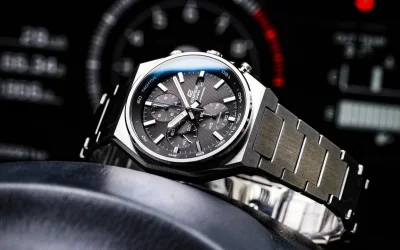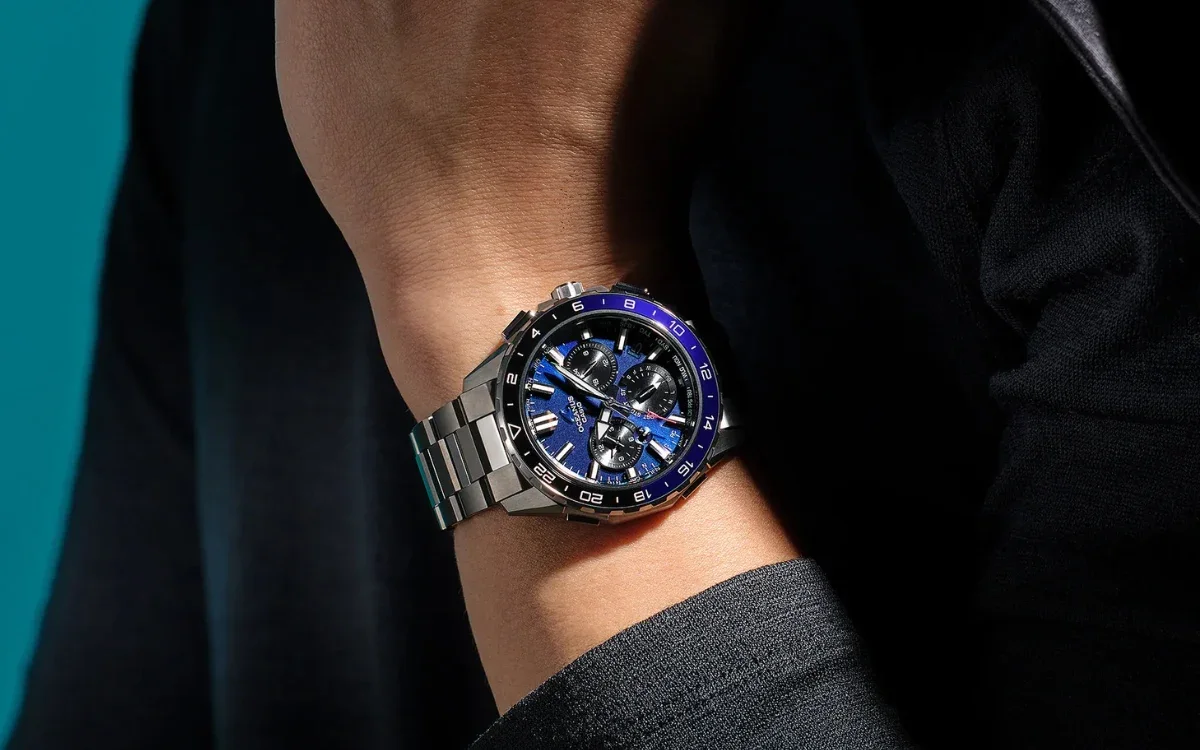
Casio has introduced three new Oceanus models under the Cachalot OCW-P3000 series, set to go on sale in Japan in October 2026.
The lineup includes the OCW-P3000-2A, OCW-P3000-3A, and the DLC-coated OCW-P3000B-1A.
Instead of digital menus, the watches rely on a physical system Casio calls the Time Zone Navigator.
How the Time Zone Navigator works
Pressing a side button moves the seconds hand to point at a city on the dial where local time is currently midnight.
The wearer then rotates the bezel so its triangle marker aligns with the seconds hand.
After that, the 24-hour scale on the bezel lines up with 26 city codes around the dial, allowing time in those locations to be read at a glance.
The bezel uses a ceramic insert with a two-tone design that separates daytime and nighttime hours.
The case and bracelet are made entirely of titanium, keeping the watches relatively light at 99 grams despite measuring 47.6 x 42.9 x 11.7 mm.
The two standard models, 2A and 3A, have a titanium carbide treatment, while the 1A model features a Diamond-Like Carbon (DLC) coating for better scratch resistance.
A sapphire crystal with anti-reflective coating on both sides covers the dial.
Casio also adjusted the solar panel layout so the sub-dial can use opaque materials for better color contrast without blocking the light needed to charge the battery.
Movement, protection, and pricing
Inside, the watches run on Casio's Tough Movement 2, a solar-powered analog movement that syncs with the Casio Watches app over Bluetooth for time accuracy.
When no phone is connected, it defaults to receiving Multiband 6 radio signals.
The movement includes protections against physical shocks and magnetic fields.
A shock detection system automatically corrects the hands if a hard impact knocks them out of alignment.
A magnetic field sensor temporarily freezes the hands when strong interference is detected, preventing alignment shifts, and resumes normal operation once the field is gone.
On a full charge, the battery lasts about five months under normal use, or up to 23 months with power-saving mode turned on.
The OCW-P3000-2A and 3A will cost ¥220,000 ($1,410), while the DLC-coated OCW-P3000B-1A is priced at ¥253,000 ($1,622) when they go on sale next month.