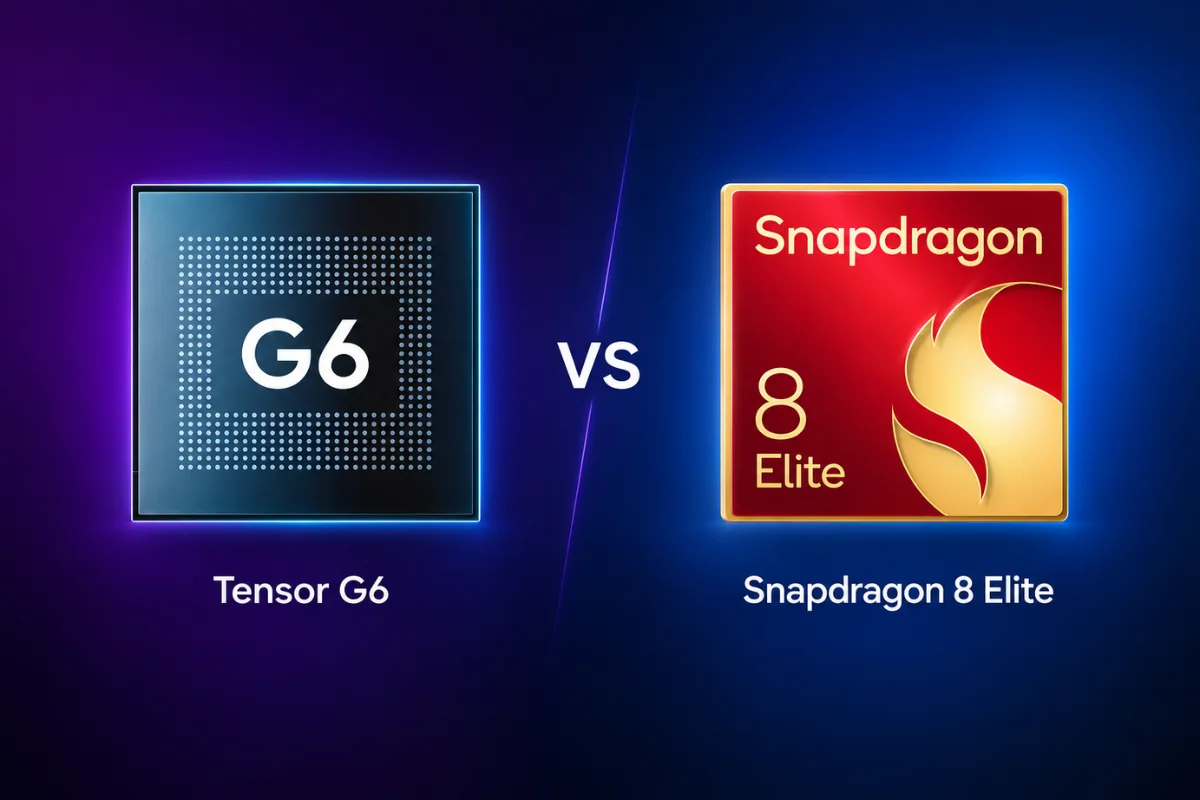
Google's new Tensor G6 chipset is out, and it brings significant upgrades in AI processing, photography, and power efficiency.
But how does it stack up against Qualcomm's Snapdragon 8 Elite? Benchmark results show a clear winner.
Spec Sheet Comparison
The Tensor G6 is built on a 3nm process, similar to the Snapdragon 8 Elite.
It features a unique 7-core CPU with ARM's newer C1-Ultra and C1-Pro cores, while the Snapdragon uses an 8-core setup with custom Oryon cores.
In terms of GPU, the Tensor G6 uses a PowerVR CXTP-48-1536, while the Snapdragon 8 Elite has an Adreno 830.
Both support LPDDR5X memory and UFS 4.0/4.1 storage, but the Snapdragon supports faster memory speeds.
For cameras, the Tensor G6 supports up to 200MP single camera and 4K portrait video, while the Snapdragon can handle up to 320MP and 8K video at 60fps.
Connectivity is similar, with both offering 5G, Wi-Fi 7, and Bluetooth 6.0, but the Tensor G6 has a slightly faster peak download speed.
Benchmark Performance
On Geekbench 6, the Tensor G6 scores 2,671 single-core and 6,802 multi-core.
The Snapdragon 8 Elite scores 3,008 single-core and 9,730 multi-core, which is 12% and 43% higher respectively.
In AnTuTu (v11), the Snapdragon 8 Elite scores 3,162,650 versus Tensor G6's 1,857,406, a difference of over 70%.
The GPU score is particularly lopsided: Snapdragon gets 1,200,291 while Tensor G6 gets 432,908, a 177% gap.
In 3DMark's Wild Life Extreme Stress Test, the Snapdragon 8 Elite scores 6,612 with an average FPS of 39.48, while the Tensor G6 scores 3,386 with 20.31 FPS.
These results show that the Snapdragon 8 Elite is far superior for gaming and heavy workloads.
The Tensor G6 focuses on AI and photography, with a larger TPU and ISP, but it sacrifices raw performance.
Overall, the Snapdragon 8 Elite outclasses the Tensor G6 in benchmarks, but the Tensor G6 offers better efficiency for on-device AI tasks.