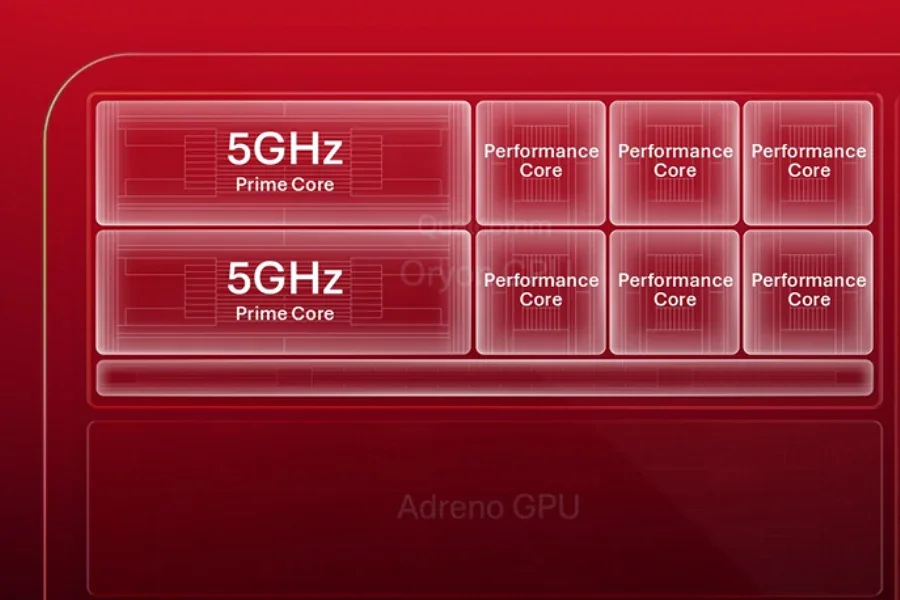
Qualcomm has revealed the first details about its upcoming flagship mobile chip, confirming that its new Oryon CPU will reach up to 5GHz.
This makes it the first mobile CPU to hit that clock speed, a milestone the company highlighted in a blog post.
Qualcomm is calling the new Oryon CPU "the world's fastest mobile CPU," attributing the achievement to two key features: the 5GHz clock speed and a new cache design called FlexCache.
The company says reaching 5GHz isn't just about a smaller manufacturing process.
Instead, Qualcomm designed the CPU architecture in-house, with each core running on its own clock domain.
This allows individual cores to speed up or slow down independently, rather than all cores running at the same speed.
Qualcomm already uses a similar approach in its Snapdragon X2 laptop chips, which also clock up to 5GHz, and is now bringing that design to smartphones.
FlexCache: A New Shared Cache Design
The other major change is FlexCache, a two-level cache design.
Each core gets its own large L1 instruction cache, while an L2 cache sits directly inside the CPU for faster access.
FlexCache then pools the L2 cache into a shared space that all CPU cores can access.
Instead of each core being stuck with its own fixed portion of cache, the system can move resources around depending on what each core needs.
Qualcomm says this could be especially useful at a time when the entire industry is dealing with memory shortages.
Keeping more data in the CPU cache means the processor doesn't have to reach out to system memory as often.
The company points to several situations where FlexCache could make a difference.
AI agents running several steps across different CPU cores can keep data in the shared cache instead of loading it again.
Games could benefit from more consistent frame rates and fewer drops.
Switching between apps could also feel faster because tasks can access data that is already sitting in the cache.
Video editing is another example.
Tasks such as decoding, applying effects, and exporting can move between different CPU cores.
With shared cache access, those tasks can pass data between cores more efficiently instead of relying as heavily on the interconnect bus.
For now, Qualcomm is only talking about the CPU.
The company says it will reveal GPU and NPU details in upcoming posts.