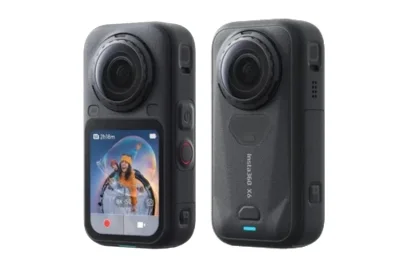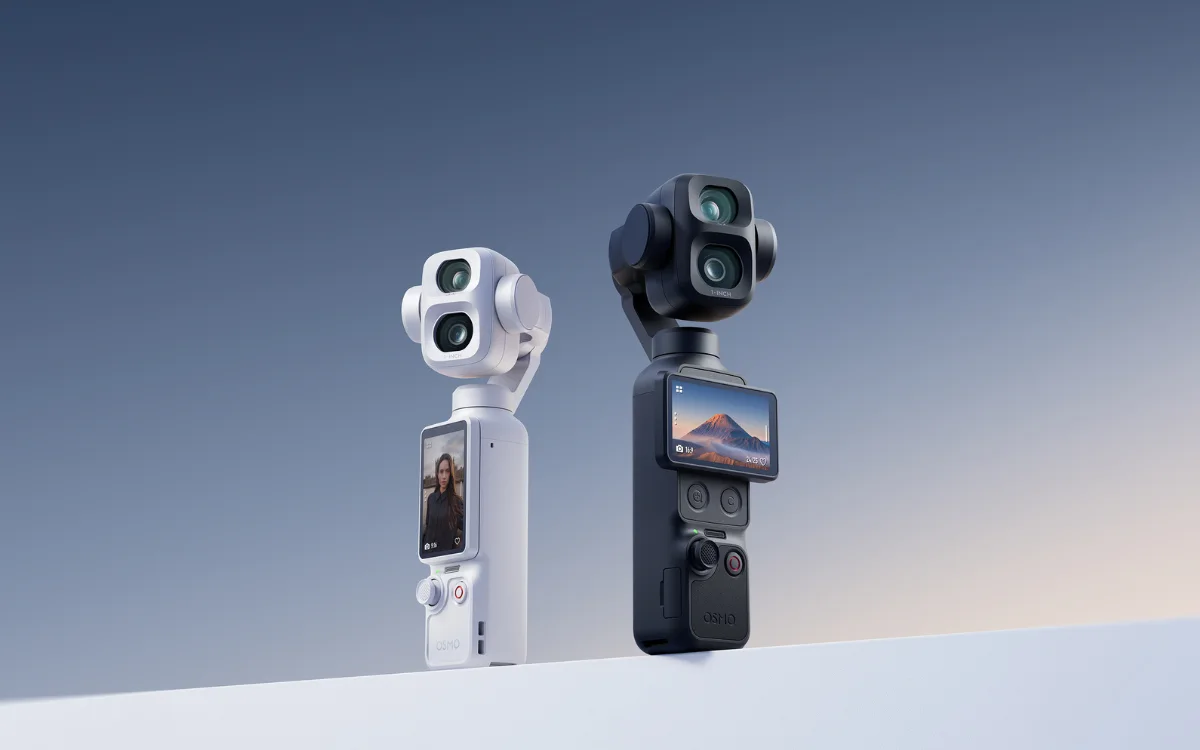
DJI has added two new handheld cameras to its lineup: the Osmo 360 II and the Osmo Pocket 4P.
Both are compact and share recent processing tech, but they serve different shooting styles.
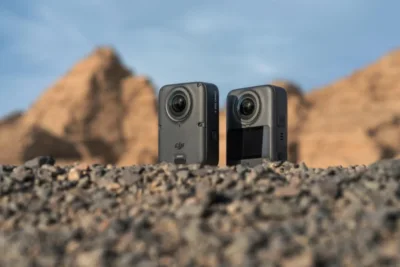
The Osmo 360 II is built for rugged, unpredictable environments. It has an IP68 rating, so it can be submerged up to 10 meters without a housing.
It also operates in temperatures as low as -20°C.
Replaceable lens protectors are a practical addition for action sports, where scratches are common. The Osmo Pocket 4P, in contrast, is more delicate.
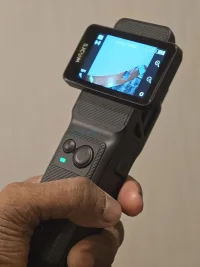
Weighing 230 grams, the Pocket 4P features a 3-axis mechanical gimbal. It is not weather-sealed or ruggedized for extreme sports, but it excels in controlled, handheld use.
A bright 2.0-inch rotating touchscreen doubles as a power switch, enabling quick start-up. It is designed for smooth, deliberate camera movements rather than rough handling.
Sensors and Image Quality
The Osmo 360 II uses dual 1/1.1-inch square CMOS sensors. This design improves sensor utilization and captures native 8K panoramic video at up to 60fps.
It offers a 14.5-stop dynamic range, 10-bit color with D-Log M, and an AI Super Night 2.0 mode for low light.
The appeal is capturing everything around you and framing later in post.
The Pocket 4P takes a traditional approach with a dual-camera system.
The main wide-angle camera has a 1-inch sensor (20mm equivalent, f/2.0) with LOFIC technology, providing up to 17 stops of dynamic range.
A secondary 60mm medium-telephoto lens (1/1.28-inch sensor, f/1.8) offers 3x optical zoom. This enables natural depth of field and background compression in portraits.
The Pocket 4P supports 4K video at up to 240fps for slow motion and uses the D-Log 2 color profile.
For standard, high-quality video straight out of the camera, it has a clear edge.
Tracking, Storage, and Battery
Both cameras offer subject tracking, but differently.
The Pocket 4P uses ActiveTrack 8.0, physically moving the gimbal to keep subjects centered, even with the telephoto lens.