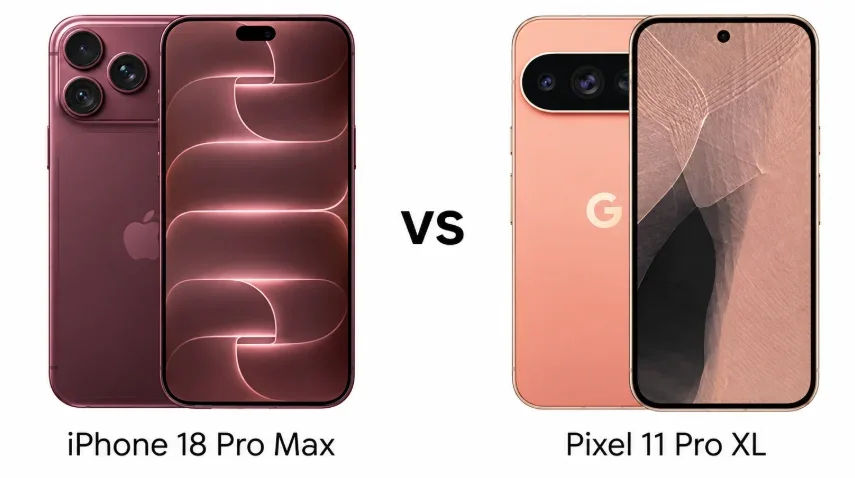
The iPhone 18 Pro Max and Google Pixel 11 Pro XL sit at the top of their respective lineups, both priced around $1,300.
Yet they take very different paths to justify that price.
Apple leans on performance, video tools, and ecosystem integration. Google counters with computational photography, AI features, and a more flexible Android experience.
Design and Display
The iPhone 18 Pro Max uses Ceramic Shield 2 on the front, an aluminum frame, and a Ceramic Shield rear, with IP68 protection.
The Pixel 11 Pro XL opts for Gorilla Glass Victus 2 on both sides, also with an aluminum frame and IP68 rating.
Apple’s build feels more purpose-built for demanding use, especially with the upgraded front protection. Google retains its distinctive styling and familiar Android flagship identity.
The iPhone features a 6.9-inch LTPO Super Retina XDR OLED with 120Hz refresh rate, HDR10, and Dolby Vision.
The Pixel offers a 6.8-inch LTPO OLED with 120Hz and HDR10+, and it claims higher peak brightness.
Google’s panel looks compelling for outdoor visibility and HDR content. Apple delivers stronger protection and Dolby Vision support, while Google pushes brightness higher.
Performance, Battery, and Camera
Under the hood, the iPhone runs Apple’s A20 Pro built on a 2nm process, paired with 12GB RAM and NVMe storage.
The Pixel uses Google’s Tensor G6 on 3nm, with up to 16GB RAM and UFS 4. x storage.
Apple’s silicon remains the more performance-focused approach, while Google emphasizes AI-driven workloads and software integration.
The higher RAM options on the Pixel are attractive, but RAM alone does not determine real-world speed.
The iPhone offers market-dependent battery capacities, with wired charging reaching 50% in 15 minutes and 25W MagSafe/Qi2 wireless charging.
The Pixel packs a 5115mAh battery with 45W wired charging, hitting 75% in 30 minutes, plus 25W magnetic wireless charging, reverse charging, and bypass charging.
Apple targets peak performance and fast initial charging, while Google provides more flexible charging features.
For performance-heavy users, Apple has the stronger package; Pixel is more versatile for charging-focused use.