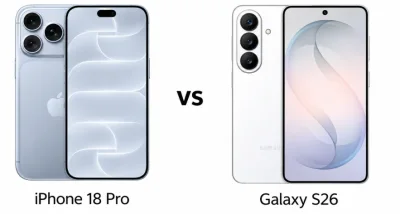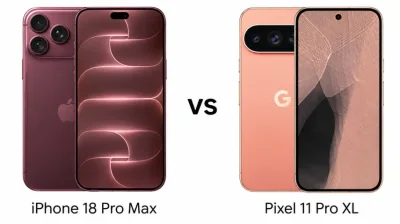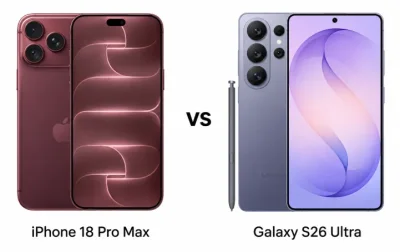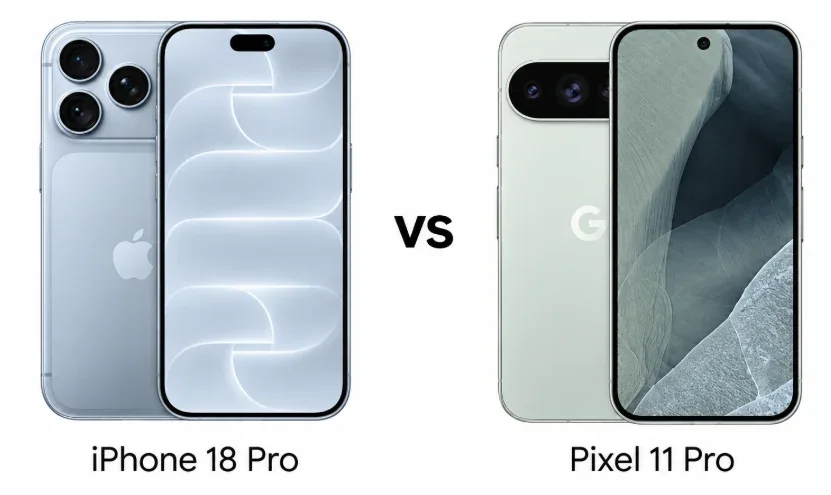
The iPhone 18 Pro and Google Pixel 11 Pro approach the premium smartphone experience from opposite directions.
Apple leans on the A20 Pro chip, advanced video tools, and a refined display, while Google pushes computational photography, a high-resolution selfie camera, and long-term Android support.
Both target the same flagship audience, so the choice comes down to performance, cameras, battery, and overall value.
Design and Display
The iPhone 18 Pro combines a Ceramic Shield 2 front with an aluminum frame and Ceramic Shield rear construction, plus IP68 protection rated for immersion up to 6 meters.
Face ID provides secure biometric authentication, and the overall hardware package remains distinctly Apple.
The Pixel 11 Pro uses Gorilla Glass Victus 2 on both sides with an aluminum frame and IP68 protection rated for immersion up to 1.5 meters.
Its under-display ultrasonic fingerprint scanner adds flexibility that the iPhone lacks.
Both phones use 6.3-inch LTPO OLED panels with 120Hz refresh rates, HDR support, and adaptive refresh technology.
The iPhone reaches 3,000 nits peak brightness and adds Dolby Vision, while Ceramic Shield 2 and an anti-reflective coating strengthen its outdoor usability and protection.
The Pixel 11 Pro counters with a sharper 1280 x 2856 resolution, 497ppi density, and up to 3,600 nits peak brightness.
Its 2,400-nit HBM rating is also higher than the iPhone’s 1,600 nits.
For pure specifications, Google’s panel has the edge, although Apple’s display remains exceptionally polished.
Apple feels better for premium build refinement and display protection, while Google offers higher brightness and sharper resolution.
The Pixel wins on display specifications; the iPhone delivers the more balanced overall package.
Performance, Battery, and Camera
The iPhone 18 Pro is powered by Apple’s A20 Pro, built on a 2nm process, paired with 12GB RAM and NVMe storage.
Its six-core CPU and seven-core GPU are designed for demanding apps, gaming, and Apple’s increasingly sophisticated on-device workloads.
The Pixel 11 Pro runs Google’s Tensor G6 on a 3nm process, with 12GB RAM on the 256GB model and 16GB on higher storage configurations.