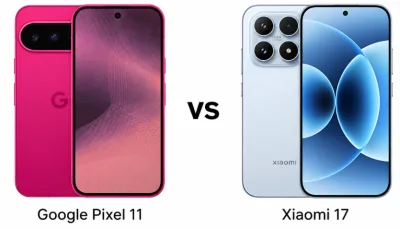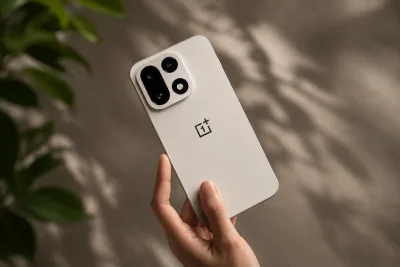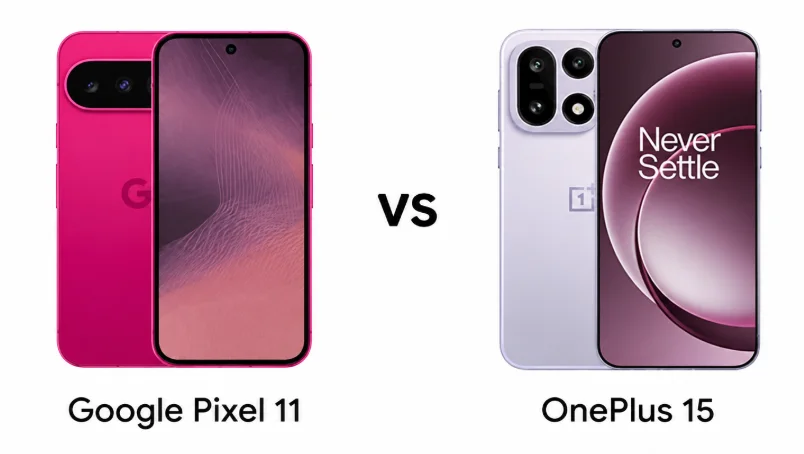
The Google Pixel 11 and OnePlus 15 represent two distinct philosophies in the flagship smartphone market. Both are priced around $900, yet they target different priorities.
The Pixel 11 emphasizes a compact design, Google's software experience, and computational photography. The OnePlus 15 pushes harder on performance, display technology, and charging speed.
With similar price tags, the question is which phone delivers more for the money. Here is how they compare across key categories.
Design and Display
The Pixel 11 features a 6.3-inch OLED display with a 120Hz refresh rate, HDR10+ support, and up to 3000 nits peak brightness.
It uses Gorilla Glass Victus 2 on both sides, an aluminum frame, and IP68 protection.
Its smaller footprint makes it easier to handle, and an ultrasonic fingerprint sensor adds a premium touch. The 1080p resolution is sensible for efficiency.
The OnePlus 15 steps up with a 6.78-inch LTPO AMOLED panel, a 165Hz refresh rate, Dolby Vision, HDR10+ and HDR Vivid support.
It also has Gorilla Glass Victus 2, an aluminum frame, and IP68/IP69K resistance.
The higher protection rating and larger, faster display make the OnePlus 15 better suited for gaming and media consumption.
OnePlus wins the display specification battle, while the Pixel remains the easier choice for users wanting a smaller screen.
Performance, Battery, and Camera
Under the hood, the Pixel 11 runs on Google's Tensor G6 chip built on a 3nm process, paired with 12GB RAM and UFS 4.
x storage. It is designed to excel at Google's AI features and tightly integrated software.
The OnePlus 15 uses the Snapdragon 8 Elite Gen 5 with up to 16GB RAM and UFS 4.1 storage.
For demanding gaming, sustained performance, and heavier multitasking, the OnePlus 15 has the more convincing hardware package.
Battery capacity is one of the biggest differences.
The Pixel 11 packs a 4985mAh battery with 30W wired and 25W wireless charging, plus Qi2.2 magnetic support and bypass charging.
The OnePlus 15 brings a huge 7300mAh silicon-carbon battery and dramatically faster 120W wired charging. It also supports 50W wireless charging, reverse wireless charging, and bypass charging.