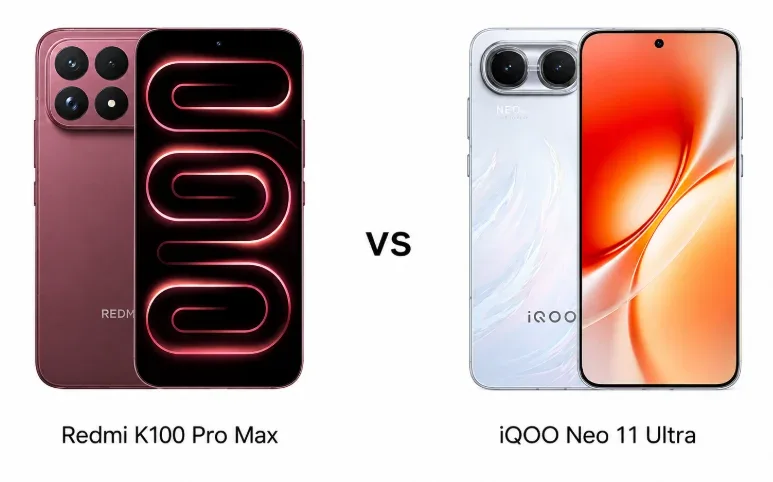
Redmi K100 Pro Max and iQOO Neo 11 Ultra take different paths in the flagship smartphone arena.
Redmi focuses on an all-round premium experience with a 200MP camera, 5x periscope zoom, and wireless charging.
iQOO targets performance enthusiasts with a powerful Dimensity chipset and a lower price.
Here’s how the two compare across design, performance, cameras, battery, and value.
Design and Display
Both phones feature glass fronts, aluminum frames, and IP68/IP69 protection, offering a premium and durable build.
Redmi adds Bose-tuned stereo audio, Dolby Atmos, and a 2.1 speaker system, enhancing multimedia experience. Both have ultrasonic in-display fingerprint scanners.
Redmi sports a 6.9-inch AMOLED with 185Hz refresh rate, Dolby Vision, HDR10+, and 4500 nits peak brightness.
iQOO counters with a 6.83-inch AMOLED, 144Hz refresh rate, 1440p resolution, and similar peak brightness.
Redmi’s display is more feature-rich for gaming and HDR, while iQOO’s higher resolution makes text and details look cleaner.
Verdict: Redmi wins for its faster refresh rate, broader HDR support, and superior speakers. iQOO offers higher resolution, but Redmi delivers a more complete entertainment-focused display package.
Performance and Battery
Redmi K100 Pro Max is powered by Snapdragon 8 Elite Gen 5, paired with UFS 4.1 storage and up to 16GB RAM.
iQOO uses Dimensity 9500M with the same storage and RAM ceiling. Both are flagship-grade, but Redmi’s Snapdragon chip offers strong appeal for demanding gaming and sustained performance.
Battery capacities are nearly identical: 9070mAh on Redmi and 9100mAh on iQOO.
Both support 100W wired charging, but Redmi adds 50W wireless charging, 27W reverse wired, and 22.5W reverse wireless.
This makes Redmi more flexible for users relying on multiple charging methods.
Verdict: Redmi takes this round with a stronger performance proposition and significantly more versatile charging. iQOO has excellent endurance, but Redmi offers a more complete flagship hardware package.
Camera System
Redmi has a major camera advantage: a 200MP primary sensor with OIS, a 50MP periscope telephoto with 5x optical zoom and OIS, and a 50MP ultrawide.
iQOO uses a 50MP main camera with OIS and an 8MP ultrawide, with no dedicated telephoto lens.