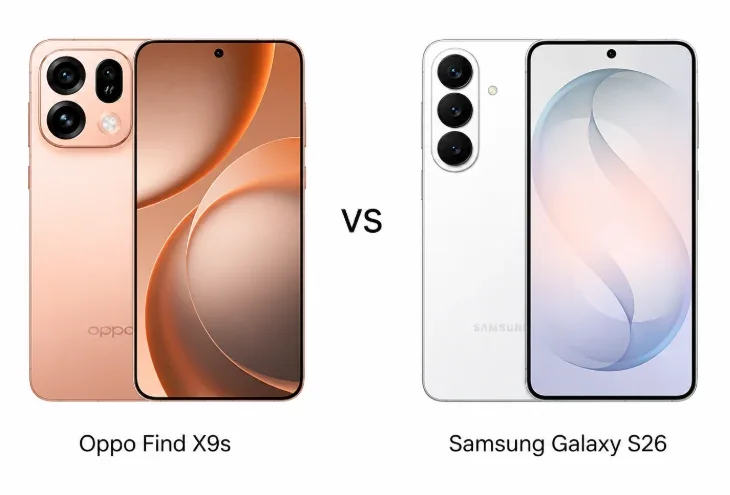
Choosing between the Oppo Find X9s and Samsung Galaxy S26 is not straightforward.
Oppo focuses on battery capacity, charging speeds, and display specifications, while Samsung emphasizes refinement, software longevity, and ecosystem features.
>>> iPhone 18 Pro's Moving Lens Camera System Is Expensive, but Apple Plans to Absorb the Cost
Design and Display
The Oppo Find X9s features a glass-and-aluminum build with IP68/IP69 protection, offering resistance against dust, water, and high-pressure water.
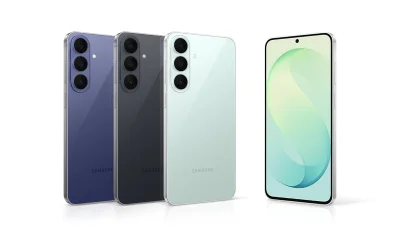
The Samsung Galaxy S26 uses Gorilla Glass Victus 2 on both sides and an Armor Aluminum 2 frame with IP68 certification.
Samsung's compact design is more manageable for everyday use, while Oppo's larger body provides a more immersive experience.
Oppo's 6.59-inch AMOLED display supports 120Hz refresh rate, Dolby Vision, 3,600 nits peak brightness, and 1256 x 2760 resolution.
It also covers 1 billion colors and 3840Hz PWM dimming.
Samsung's 6.3-inch Dynamic LTPO AMOLED 2X display offers adaptive refresh, HDR10+, and 2,600 nits peak brightness.
Oppo leads in display specifications and durability, while Samsung delivers a refined, balanced panel.
>>> Snapdragon C Specs Leak: 6nm Chip for $300 Windows Laptops
Performance and Battery
The Oppo Find X9s is powered by the MediaTek Dimensity 9500s chipset with UFS 4.1 storage and 12GB RAM.
Samsung equips the Galaxy S26 with either Snapdragon 8 Elite Gen 5 or Exynos 2600, depending on region, and promises up to seven major Android upgrades.
Battery life is a key differentiator. Oppo packs a 7,025mAh silicon-carbon battery with 80W wired charging.
Samsung includes a 4,300mAh battery with 25W wired, 15W wireless, and reverse wireless charging.
Oppo dominates battery capacity and charging speed, while Samsung offers wireless convenience and longer software support.
Camera System
The Oppo Find X9s features a triple 50MP camera setup: wide, telephoto with 3x optical zoom, and ultrawide.
It includes Hasselblad color tuning and records 4K video at up to 120fps.
>>> HyperOS 3.1 Update Reaches 40 Xiaomi, Redmi, and Poco Devices Globally
Samsung's Galaxy S26 uses a 50MP main sensor, 10MP telephoto with 3x zoom, and 12MP ultrawide, with 8K video recording and features like Best Face and Horizon Lock.
Oppo's camera hardware is stronger on paper, but Samsung's computational photography and video capabilities remain competitive.
For selfies, Oppo has a 32MP front camera with 4K 60fps recording, while Samsung offers a 12MP dual-pixel camera with reliable autofocus.
Pricing and Value
The Oppo Find X9s is priced around $730 (approximately ₹60,000), while the Samsung Galaxy S26 costs about $900 (approximately ₹88,000).
Oppo delivers a larger battery, faster charging, higher-resolution display, and triple 50MP camera for a lower price.
Samsung's higher cost reflects software commitment, DeX desktop mode, wireless charging, and ecosystem integration.
From a specifications perspective, Oppo offers significantly better value. Samsung's premium is justified for users prioritizing long-term software support and ecosystem features.
>>> Vivo S60 and S60 Vitality Edition Launch with 144Hz Display, 50MP Selfie Camera
Both devices represent different interpretations of a modern flagship. Oppo prioritizes performance, endurance, and hardware innovation, while Samsung focuses on refinement, longevity, and software excellence.