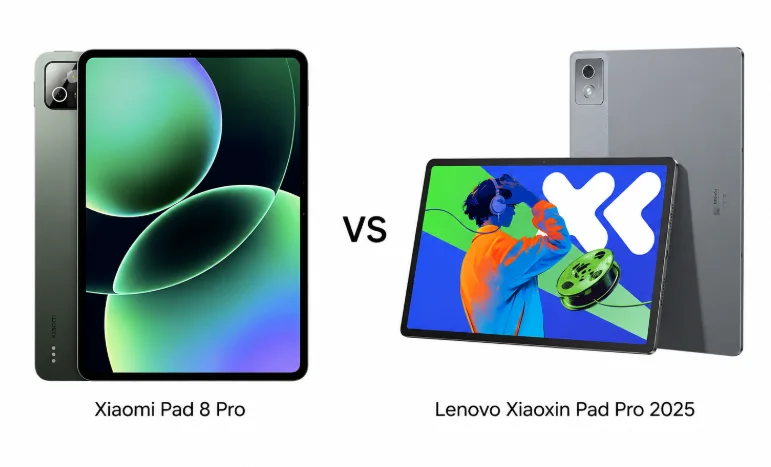
Choosing between the Xiaomi Pad 8 Pro and the Lenovo Xiaoxin Pad Pro 2025 is not straightforward.
One focuses on flagship performance and premium hardware, while the other prioritizes a larger display, productivity features, and aggressive pricing.
Design and Display
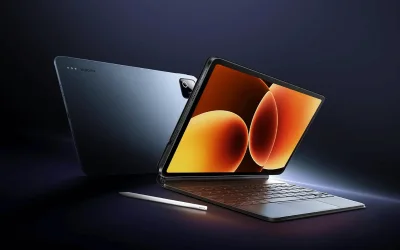
The Xiaomi Pad 8 Pro features a slim 5.8mm aluminum unibody and weighs around 485g, making it more portable.
It supports a magnetic stylus and has a clean flagship aesthetic.
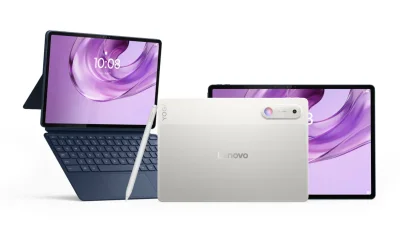
The Lenovo Xiaoxin Pad Pro 12.7 2025 is larger, built for productivity. It includes a side-mounted fingerprint scanner and POGO pins for accessories.
Xiaomi offers an 11.2-inch 3.2K IPS panel with Dolby Vision, HDR Vivid, 800 nits peak brightness, and a 144Hz refresh rate.
Lenovo counters with a 12.7-inch 2.9K LCD, also 144Hz, with HDR10+ and Dolby Vision. The larger screen benefits multitasking and media consumption.
Performance and Software
The Snapdragon 8 Elite in the Xiaomi Pad 8 Pro delivers flagship-level CPU and GPU performance.
With up to 16GB RAM and UFS 4.1 storage, it handles demanding gaming and video editing.
The Lenovo tablet uses the MediaTek Dimensity 8300, a strong upper-midrange chip.
Daily tasks and casual gaming run smoothly, but it cannot match the raw power of Xiaomi's offering.
Lenovo's larger display aids split-screen work and multitasking. MicroSD expansion adds flexibility.
Xiaomi runs Android 16-based HyperOS 3, with faster storage and performance that should age better.
Battery and Accessories
Xiaomi packs a 9200mAh battery with 67W fast charging and reverse wired charging. Lenovo has a larger 10200mAh battery for longer screen-on time, though charging is slower.
Both support stylus and keyboard accessories. Xiaomi benefits from HyperOS ecosystem integration.
Lenovo's POGO pins and expandable storage suit productivity setups.
Cameras and Media
Xiaomi offers a 50MP rear camera and a 32MP ultrawide front camera, better for video calls and document capture.
Lenovo has a 13MP rear and 8MP front camera, adequate for basics.
Xiaomi supports 4K 60fps recording and Dolby Atmos audio. Lenovo features a four-speaker JBL system with Dolby Atmos, excellent for movies and music.
Pricing
The Xiaomi Pad 8 Pro is expected around $500 (approx. ₹47,000).
The Lenovo Xiaoxin Pad Pro 12.7 2025 targets a lower price bracket while offering a large display, solid performance, expandable storage, JBL speakers, and a larger battery.
Conclusion
The Xiaomi Pad 8 Pro is the better tablet overall with its flagship chipset, superior cameras, faster charging, and newer software.
It is a stronger long-term investment for power users and gamers.
The Lenovo Xiaoxin Pad Pro 12.7 2025 is the smarter choice for buyers prioritizing screen size, battery life, productivity, and value.
For entertainment and everyday work, it delivers an impressive experience at a more accessible price.