The mid-range smartphone market is fiercely competitive, with brands constantly pushing boundaries to offer premium features at accessible prices.
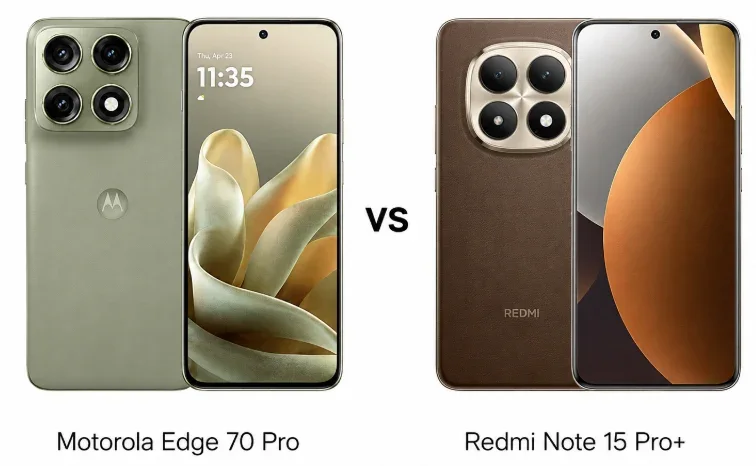
Two of the most talked-about contenders are the Motorola Edge 70 Pro and the Redmi Note 15 Pro+.
Each device takes a distinct approach: one focuses on delivering a flagship-like experience with versatile cameras and wireless charging, while the other emphasizes raw value with a massive sensor and ultra-fast charging.
This comparison breaks down their key differences to help you decide which phone suits your needs better.
Design and Display
The Motorola Edge 70 Pro adopts a slimmer, more premium design with an eco-leather finish and curved edges.
It feels refined and lightweight, giving it a flagship-like personality.
Its IP68/IP69 rating and MIL-STD-810H certification add durability confidence.
The Redmi Note 15 Pro+ takes a tougher route with Gorilla Glass Victus 2, enhanced drop resistance, and stronger water protection.
Redmi's build feels more solid and rugged, though less sleek than the Motorola.
For display, the Edge 70 Pro boasts a 6.78-inch AMOLED panel with a 144Hz refresh rate and peak brightness of 5200 nits.
This makes animations and scrolling exceptionally smooth, even under direct sunlight.
The Redmi Note 15 Pro+ features a 6.83-inch AMOLED display with 120Hz refresh rate and 3200 nits peak brightness.
It supports Dolby Vision and HDR10+, which may be easier on the eyes during night use.
Overall, the Motorola wins on display smoothness and brightness, while Redmi offers better durability and multimedia comfort.
Performance and Storage
Under the hood, the Motorola Edge 70 Pro is powered by the Dimensity 8500 Extreme chipset paired with a Mali-G720 MC8 GPU.
It uses faster UFS 4.1 storage, ensuring quicker app loading and data transfers.
The Redmi Note 15 Pro+ runs on the Snapdragon 7s Gen 4 with an Adreno 810 GPU and slower UFS 2.2 storage.
For everyday tasks and casual gaming, the Redmi performs reliably, but heavy users will notice the difference in speed.
The Motorola offers superior gaming capability and multitasking performance. Both phones come with up to 12GB of RAM and 512GB of storage, making them equally configurable.