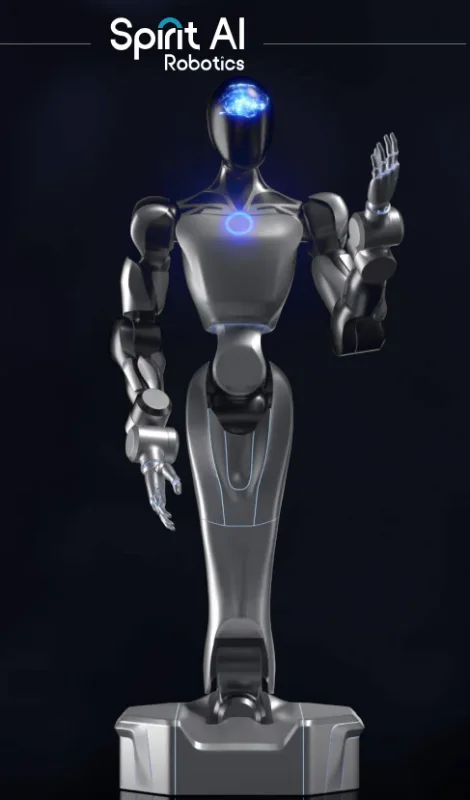
Chinese startup Spirit AI has claimed the top spot on the RoboArena benchmark with its Spirit v1.6 model, surpassing NVIDIA and other major competitors.
The achievement signals China's growing strength in physical AI, the technology that powers robots and autonomous systems.
Spirit v1.6 scored 1,924 points on the benchmark, beating NVIDIA's Cosmos3-Nano-Policy (1,881) and DreamZero (1,763).
This is the first time a Chinese embodied AI model has reached the No.1 position on RoboArena.
What RoboArena Measures
RoboArena evaluates how well AI systems translate decisions into real-world robotic actions.
Unlike benchmarks focused on language or reasoning, it tests physical task execution such as object manipulation, navigation, tool usage, perception, planning, and adaptability in unfamiliar environments.
The benchmark uses randomized environments, adversarial testing, and strict anti-overfitting measures, making it difficult for companies to optimize specifically for the test.
Spirit AI's model demonstrated strong performance in object handling, autonomous navigation, complex tool use, and adapting to new situations with minimal fine-tuning.
The company's success suggests that efficient model design and high-quality training data can rival massive computing power.
China's Growing Robotics Ecosystem
China has been gaining ground across several embodied AI benchmarks.
Companies like Manifold AI, AgiBot, and DexForce lead categories related to world modeling, robotic perception, and robotics data generation.
Investment in the sector continues to surge.
Spirit AI recently raised 1.5 billion yuan (about $222 million), while other Chinese robotics startups have secured large funding rounds over the past year.
China's growing strength in robotics data, funding, and benchmark performance indicates the global race is becoming more competitive.
The competition in artificial intelligence is increasingly shifting from chatbots and large language models toward physical AI, which serves as the "brains" behind humanoid robots, robotic arms, autonomous vehicles, and industrial automation platforms.