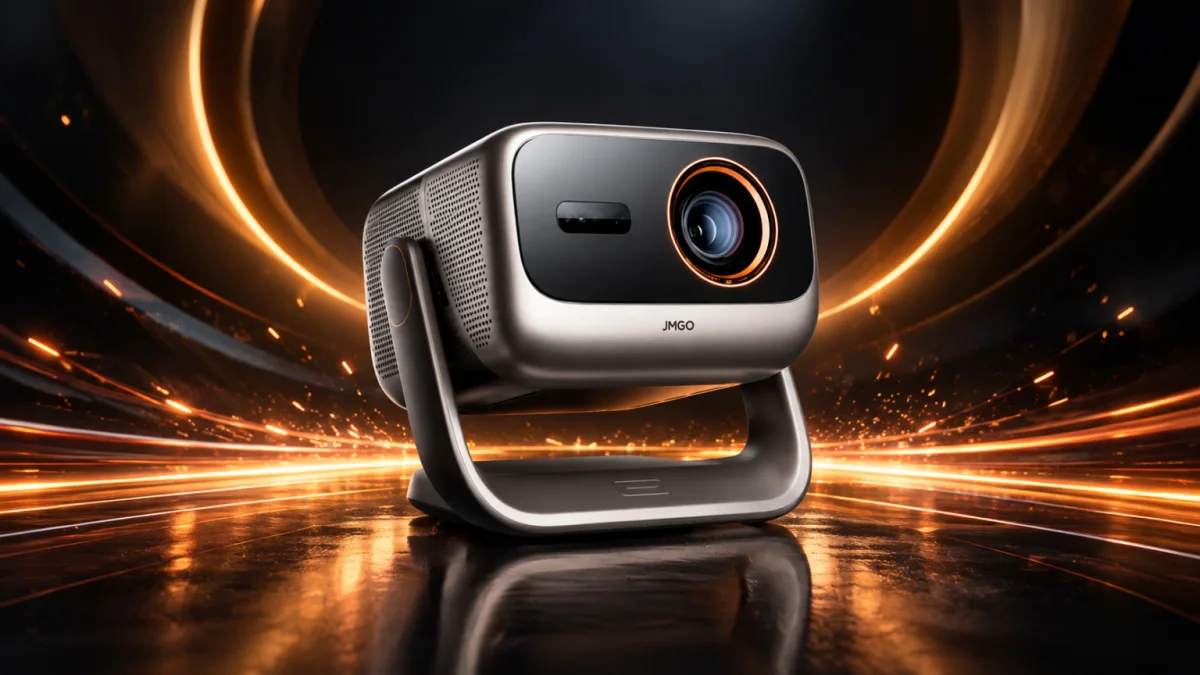
Projectors have spent the past few years trying to replace televisions, but the best models of 2026 are becoming something more versatile.
They are high-performance display systems that can transform a living room, backyard, studio, or conference space into a massive screen without requiring a dedicated theater.
The latest generation brings higher brightness, laser light sources, automatic image correction, Google TV, gaming features, and, in some cases, advanced optical systems.
But choosing between them can be complicated.
ISO lumens, contrast ratios, lens shift, optical zoom, RGB triple lasers, and AI processing can quickly become overwhelming, especially when manufacturers present these technologies differently.
After comparing some of the most capable options currently available, these are the projectors that stand out in 2026.
Xgimi Titan
The Xgimi Titan is built for people who need a projector that can overpower ambient light.
It produces 5,000 ISO lumens, which puts it well above most home-focused models.
That brightness gives it a major advantage in living rooms with windows, storefront displays, studios, gyms, and conference spaces.
You do not need to treat every daytime viewing session like a blackout-curtain project.
Xgimi uses a large 0.78-inch DMD imaging chip in the Titan. Most compact 4K DLP projectors use a smaller 0.47-inch chip.
The larger chip gives Titan more room to maintain image detail and brightness at larger sizes.
This matters if you want a projection that feels more like a true theater screen than an oversized television.
The Titan also includes a dual-laser light engine, Dolby Vision, HDR10+, IMAX Enhanced, Filmmaker Mode, and 3D support.
Its claimed 150% DCI-P3 color gamut and 5,000,000:1 dynamic contrast ratio aim to deliver saturated color and deeper shadow detail, even when the room is not fully dark.
Its lens system is one of its strongest features. The projector supports motorized lens shift up to ±100% vertically and ±40% horizontally, along with optical zoom.
These controls let you move the image without using digital keystone correction. That is important because optical adjustment preserves sharpness, while aggressive keystone correction can reduce image quality.