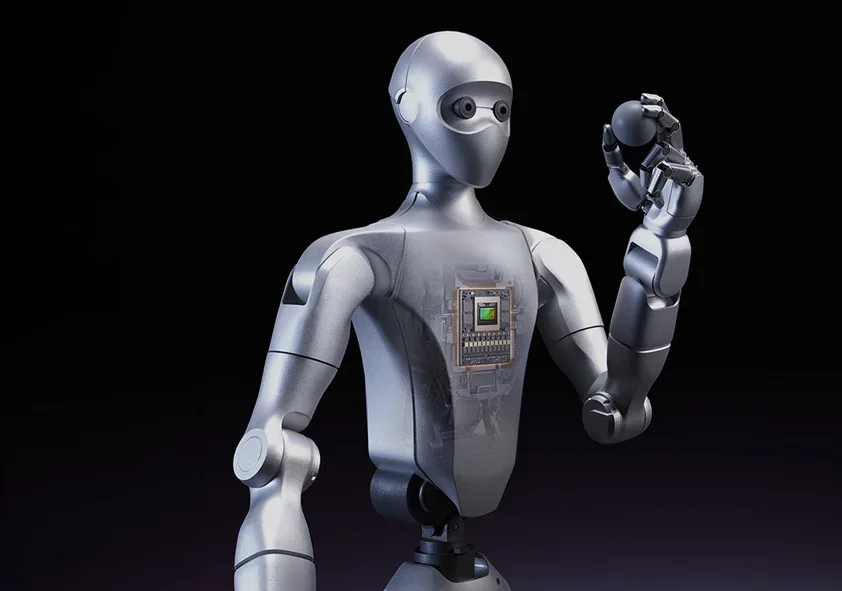
Nvidia has unveiled the H2+ reference robot platform, developed with China's Unitree Robotics and Singapore-based Sharpa.
CEO Jensen Huang announced the project during his Computex 2026 keynote in Taipei.
The platform combines advanced AI, robotics hardware, and software into a unified design aimed at accelerating humanoid robot development.
What Is the H2+ Platform?
H2+ is not a finished commercial robot but a reference design.
Researchers, universities, and companies can use it as a blueprint to build and customize their own humanoid robots.
Nvidia says the platform simplifies every stage of robot development, from data collection and AI training to real-world deployment.
Hardware and AI Integration
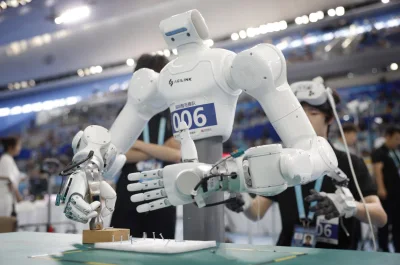
The H2+ platform integrates Unitree's H2 Plus humanoid robot body, Sharpa's Wave robotic hands, and Nvidia's Isaac GR00T AI models.
It is powered by the new Jetson AGX Thor T5000 computer based on the Blackwell GPU architecture.
The robot stands nearly six feet tall and offers 75 degrees of freedom, including hands with 22 active joints.
The Jetson AGX Thor T5000 delivers up to 2,070 FP4 TOPS of AI performance and includes 128GB of memory for real-time complex tasks.
Cosmos 3 World Model
Alongside H2+, Nvidia introduced Cosmos 3, a physical AI world model. It helps robots understand and learn from their environments by processing both third-person and first-person perspectives.
Huang noted that collecting enough training data is a major challenge in robotics. Cosmos 3 generates robot-centric training data to improve learning and decision-making.
Global Expansion Plans
Nvidia plans to expand humanoid robot partnerships beyond China, targeting robot makers in the United States, Europe, and South Korea.
Specific partner names have not been announced.
The company aims to create standardized robot platforms with built-in security features like Secure Boot and Confidential Computing to ensure only verified software runs on the machines.
Market Context
The announcement comes amid growing interest in humanoid robots.
Morgan Stanley analysts expect China's humanoid robot sales to exceed 28,000 units in 2026, potentially making it the world's largest market.
With H2+, Cosmos 3, and new international partnerships, Nvidia is positioning itself at the center of the expanding humanoid robotics industry, supplying AI hardware, software, and development tools for next-generation intelligent machines.